
Key Takeaways
-
The art nouveau era (c. 1890–1910) revolutionized jewelry design by replacing rigid Victorian styles with flowing “whiplash” lines, sensual female figures, and nature-inspired themes drawn from dragonflies, orchids, and mythological creatures.
-
Signature techniques include plique-à-jour enamel (creating a stained-glass effect), alongside materials like moonstones, opals, carved horn, and cabochon-cut gems—chosen for artistic impact rather than intrinsic value.
-
Key art nouveau designers such as René Lalique, Georges Fouquet, and Masriera created pieces now housed in major museums worldwide, with authentic works commanding premium auction prices.
-
Original art nouveau jewelry pieces are rare collectibles requiring specialized care, but their aesthetics can be recreated ethically through custom design using lab-grown stones and modern craftsmanship.
-
Trabert Goldsmiths offers curated vintage art nouveau pieces, expert restoration services, and custom Art Nouveau–inspired designs for clients in the San Francisco Bay Area and beyond.
Introduction to the Art Nouveau Era (c. 1890–1910)
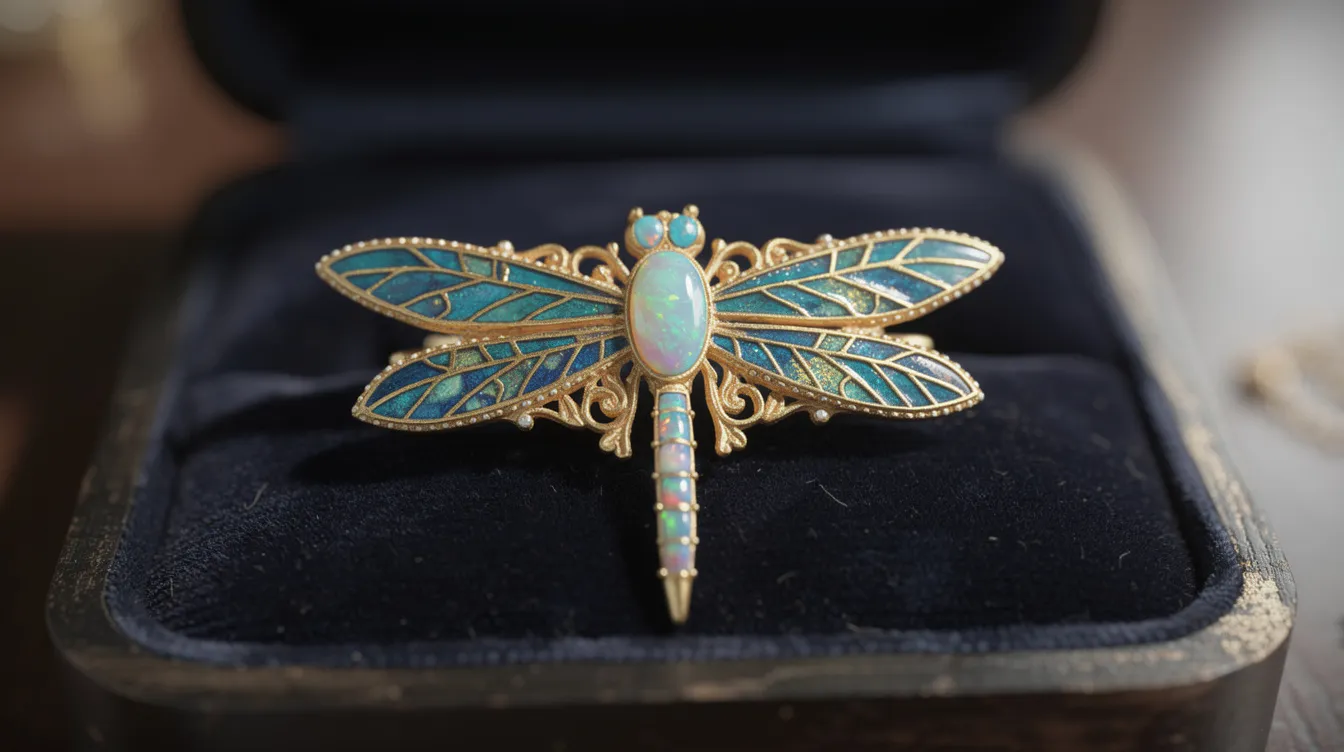
Imagine a brooch that seems to breathe. Crafted around 1900, a dragonfly hovers on your lapel—its wings rendered in plique-à-jour enamel that glows like cathedral glass when light passes through, its body formed from a luminous opal that shifts between blue fire and green, and delicate gold tendrils curling beneath in the sinuous curves that define the era. This is art nouveau jewelry at its finest: not merely an ornament, but a miniature sculpture that captures the fleeting beauty of the natural world.
The term art nouveau—French for “new art”—emerged in the 1890s to describe a deliberate attempt to break free from the imitative historicism that had dominated the decorative arts throughout the Victorian era. Named after Samuel Bing’s influential Paris gallery, l’art nouveau, which opened in 1895, the movement flourished during what the French called the art belle époque and the broader art fin de siècle period. For roughly two decades (1890–1910, with peak activity between 1895 and 1905), art nouveau transformed all the arts: architecture, interior design, posters, glass, and most magnificently, jewelry.
This was the moment when jewelry design became a recognized branch of the fine arts. Jewelers stopped functioning as mere setters of precious stones and began working as sculptors seeking reform in how adornment could express human creativity. The rigid symbolism and overwrought ornamentation of Victorian jewelry gave way to sensual, flowing lines drawn directly from nature—a radical shift that prioritized artistic vision over the display of wealth.
The art nouveau movement spread across western europe under various regional names: Jugendstil in Germany (meaning “young art”), stile liberty and stile floreale in Italy, arte nuova in other Italian contexts, Modernisme in Catalonia, and Modern Style in Britain. Each variant shared the same core philosophy: handcrafted beauty that rejected mass production in favor of individual artistic expression.
At Trabert Goldsmiths in San Francisco, we’ve spent over two decades collecting, restoring, and drawing inspiration from this extraordinary period. Whether you’re seeking an original period piece or a custom design that echoes the era’s flowing aesthetics, understanding art nouveau jewelry opens a window into one of history’s most creative moments in adornment.
Defining Aesthetics of Art Nouveau Jewelry
Art nouveau jewelry is instantly recognizable once you understand its visual language. Unlike the symmetrical, gem-heavy designs that preceded it, art nouveau designs embrace asymmetry, movement, and organic forms that seem to grow and flow like living things. Here’s how to identify the key aesthetic elements that define the style.
The Whiplash Line
The most distinctive feature of art nouveau style is what the French called the style coup de fouet or coup de fouet—the “whiplash” line. These are long, sinuous, asymmetrical curves that suggest natural movement: vines climbing a trellis, waves rolling toward shore, or wind bending a stem of grass. In jewelry, whiplash lines wrap around gemstones, connect multiple motifs, and create a sense of continuous rhythm. The style nouille (literally “noodle style”) was another French nickname for these soft curves that seemed almost liquid in their fluidity.
Unlike Victorian pieces where decorative elements stood separate and static, art nouveau jewelers used curving lines to unify entire compositions. A single flowing curve might begin as a flower stem, transform into a woman’s hair, and end as a butterfly’s wing—all in one seamless movement.
Nature Motifs
The natural world provided the primary vocabulary for art nouveau jewelry. Jewelers looked to taking inspiration from botanical specimens and creatures that Victorian society had largely ignored:
|
Botanical Motifs |
Symbolic Meaning |
|---|---|
|
Iris |
Wisdom, courage |
|
Lily |
Purity, renewal |
|
Orchid |
Luxury, exotic beauty |
|
Poppy |
Dreams, sleep, oblivion |
|
Ginkgo leaf |
Longevity, hope |
|
Animal Motifs |
Symbolic Meaning |
|---|---|
|
Dragonfly |
Transformation, adaptation |
|
Butterfly |
Soul, metamorphosis |
|
Peacock |
Immortality, beauty |
|
Swan |
Grace, poetry |
|
Serpent |
Eternal love, wisdom |
|
Bat |
Night, the subconscious |
|
Swallow |
Hope, homecoming |
These natural motifs weren’t chosen randomly. The dragonfly, for instance, became perhaps the most iconic art nouveau creature because its iridescent wings and hovering flight perfectly suited plique-à-jour enamel techniques and the era’s fascination with transformation and fleeting beauty. Serpents, with their ability to shed skin and form perfect circles, symbolized eternity and were heavily influenced by Symbolist philosophy.
The Female Figure
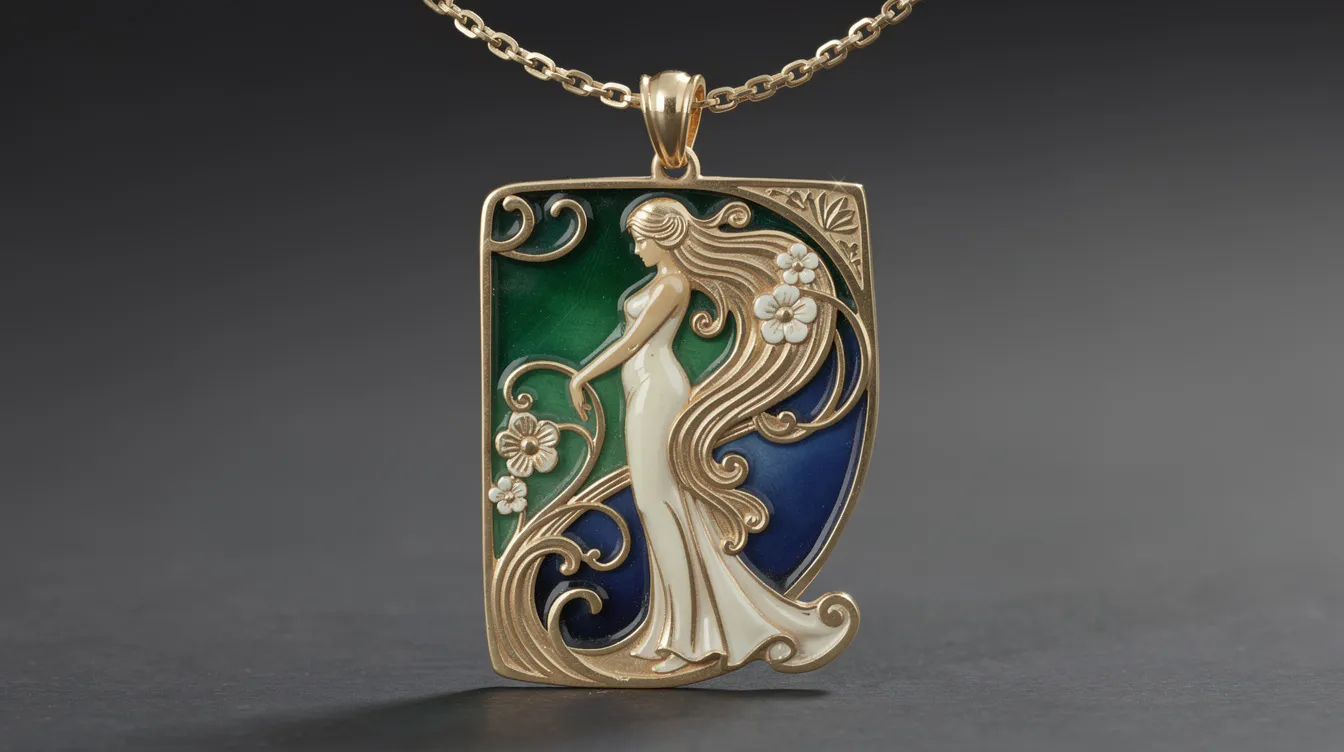
Central to art nouveau jewelry is the female form rendered in ways that would have shocked Victorian sensibilities. Nymphs, sirens, winged women, and muses appeared on pendants, brooches, and hair ornaments—their bodies often partially nude, their flowing hair merging seamlessly into floral motifs or insect wings.
This wasn’t decorative whimsy but a deliberate artistic statement. The female figure in art nouveau represented a new ideal of femininity: sensual, liberated, connected to nature, and possessed of mysterious inner power. These women weren’t passive ornaments but active presences with unruly aspects of beauty that challenged Victorian restraint.
Compositional Characteristics
Several technical choices distinguish art nouveau compositions:
-
Asymmetry: Unlike the balanced, mirrored designs of earlier periods, art nouveau pieces deliberately avoid perfect symmetry
-
Elongated proportions: Figures and forms stretch vertically, creating elegance and drama
-
Layered relief: Multiple levels of depth create shadow and dimension
-
Sculptural modeling: Pieces feel three-dimensional, more like miniature sculptures than flat settings
A famous work illustrating these principles is René Lalique’s c. 1902 pendant featuring a woman’s profile surrounded by enamel orchids. The composition is deliberately off-center, the woman’s features elongated and idealized, and the orchids overlap in layered relief—creating what feels like a wearable painting rather than a conventional jewel.
Georges Fouquet’s collaborations with the graphic artist Alphonse Mucha around 1899–1901 pushed these aesthetics even further into theatrical, symbolist territory, producing jewels that resembled miniature stage sets populated by mysterious, powerful women.
Techniques, Materials & Gemstones of the Era
Art nouveau jewelers made a radical choice: they valued artistic effect over the intrinsic value of materials. A beautifully crafted horn comb might be prized above a diamond tiara. This philosophy produced some of the most technically demanding and visually stunning jewelry ever created.
Enameling Techniques
Enamel work defined art nouveau jewelry, allowing jewelers to introduce color, translucency, and painterly effects impossible with gemstones alone.
Plique-à-jour (meaning “letting in daylight”) remains the most celebrated technique. Enamel is applied in cells with no backing, creating a translucent, stained-glass effect when light passes through. This technique was ideal for rendering insect wings, flower petals, and water effects. French and Belgian jewelers between c. 1895–1910 brought plique-à-jour to its highest expression, though it remains extremely difficult to execute—the enamel must be fired multiple times without any supporting backing, and pieces frequently crack or fail.
Other enameling methods complemented plique-à-jour:
|
Technique |
Description |
Typical Use |
|---|---|---|
|
Cloisonné |
Wire cells filled with enamel |
Defined color areas, geometric florals |
|
Champlevé |
Engraved cavities filled with enamel |
Bold color fields, backgrounds |
|
Basse-taille |
Translucent enamel over engraved metal |
Subtle shading, textural depth |
Each method required painstaking hand-labor with unpredictable results during firing, imprinting the maker’s touch into every piece.
Gemstone Preferences
Art nouveau jewelers chose gems for their color and soft luminescence rather than brilliance or fire:
-
Opals: Prized for their fiery play-of-color, opals became quintessential art nouveau stones
-
Moonstones: Valued for their adularescence—that soft, floating glow beneath the surface
-
Cabochon cuts: Smooth, domed shapes that emphasize color over faceted sparkle
-
Semi-precious stones: Amethysts, peridots, citrines, garnets, and turquoise chosen for specific color effects
A c. 1900 moonstone and enamel pendant might combine a glowing cabochon with delicate plique-à-jour wings, creating an otherworldly effect impossible with diamonds. This represented a complete inversion of Victorian values, where diamonds and rubies signaled wealth and status. In art nouveau, artistic vision trumped carat weight.
Unconventional Organic Materials
Perhaps nothing distinguishes art nouveau from other jewelry periods quite like its embrace of organic materials:
-
Carved horn: Dyed or translucent sheets carved into combs, tiaras, and brooches
-
Tortoiseshell: Warm, patterned material for hair ornaments
-
Ivory and bone: Carved for cameo-like effects
-
Mother-of-pearl: Iridescent backing and inlay
-
Glass: Art glass in the tiffany style brought new possibilities
René Lalique and Lucien Gaillard became masters of horn work, creating hair combs and decorative objects that captured the translucency of dragonfly wings or autumn leaves. These materials demanded different skills than metalworking—more akin to sculpture than traditional goldsmithing.
Metals and Craftsmanship
Yellow gold in 18k remained the primary metal, often worked in ways that showcased the jeweler’s hand:
-
Patinated or oxidized finishes: Adding depth and age
-
Pierced work: Creating lacy, open patterns
-
Chased and repoussé surfaces: Hammered relief from both sides
-
Bi-metal construction: Gold on silver for color contrast
These pieces required hand-piercing, chasing, repoussé, and wax modeling for lost-wax casting—techniques that simply couldn’t be replicated through mass production. Every curve, every surface texture revealed the artist’s direct involvement.
At Trabert Goldsmiths, we continue many of these historic techniques in our San Francisco workshop. When restoring original art nouveau pieces or creating new designs inspired by the era, we draw on the same hand-crafting methods that Lalique and his contemporaries perfected over a century ago.
Key Art Nouveau Jewelry Designers & Houses
The art nouveau movement in jewelry was driven by a handful of visionary artist-jewelers who elevated the craft to high art. Their signed pieces now anchor museum collections and command extraordinary prices at auction. Understanding these art nouveau designers helps collectors identify important works and appreciate the movement’s creative range.
René Lalique (French, 1860–1945)
No figure looms larger over art nouveau jewelry than René Lalique. Active in jewelry from approximately 1890 to 1910, Lalique was the most important figure who transformed how the world understood what jewelry could be.
Lalique exhibited at the 1900 Paris Exposition Universelle to international acclaim. His work represented art nouveau bing in its fullest expression—pieces named for and inspired by the aesthetic that Samuel Bing’s gallery had championed. He created female masks with flowing hair, dragonflies with translucent wings, peacocks in full display, and orchids that seemed to bloom from gold stems.
His famous Dragonfly Woman corsage ornament (c. 1897–1898) exemplifies his radical vision: a woman’s body transforms into a dragonfly, with plique-à-jour enamel wings, carved chrysoprase, moonstones, and gold worked with the fluidity of sculpture. The piece prioritizes innovation over luxury—horn and enamel matter as much as gems.
Lalique later transitioned to glass work (his name now more associated with perfume bottles), but his jewelry period remains his most celebrated achievement. Authentic Lalique jewelry pieces regularly fetch six figures at auction.
Georges Fouquet (French, 1862–1957)
Georges Fouquet brought an architectural sensibility to art nouveau jewelry, creating pieces that felt monumental despite their small scale. His collaboration with the painter and graphic work master Alphonse Mucha around 1899–1901 produced some of the movement’s most theatrical jewels.
The Snake Bracelet created for actress Sarah Bernhardt exemplifies this partnership: a coiled serpent winds up the arm, rendered in gold and enamel with symbolic weight that transcended mere decoration. Fouquet’s 1901 Paris boutique, designed as a complete art nouveau interior, demonstrated his commitment to the movement’s total aesthetic vision.
Masriera (Barcelona, active late 1890s–1900s)
Luis Masriera brought art nouveau to Catalonia, where it merged with the local Modernisme movement championed by figures like the french architect Antoni Gaudí (though Gaudí was Catalan, the architectural influences crossed borders). Masriera excelled in vivid plique-à-jour enamel work featuring female figures and floral motifs.
His early 1900s theatrical masque pendants showcase winged women in brilliant colors—pieces that combined the movement’s internationalism with distinctly Catalan sensibilities. Masriera pieces remain highly sought by collectors for their exceptional enamel quality.
Other Notable Designers
Several other jewelers made significant contributions:
-
Lucien Gaillard (French, c. 1890–1910): Specialist in horn, enamels, and naturalistic insects and flowers, creating pieces that blurred the line between jewelry and natural history specimen
-
Henri Vever (French, c. 1890–1910): Known for delicate enameling and subtle color harmonies
-
Eugène Feuillâtre (French, c. 1890–1910): Master enamelist who created extraordinary plique-à-jour pieces
-
Louis Comfort Tiffany (American, c. 1900): The main American art nouveau figure, bringing Favrile glass techniques and nature themes to jewelry, connecting American design to the broader movement
These artists approached jewelry as sculptors seeking reform in their medium. Their signatures on a piece significantly increase its value, but more importantly, they guarantee a level of artistic ambition that mass production could never achieve.
What Collectors Seek
When evaluating art nouveau designer pieces, collectors look for:
-
Intact maker’s marks and signatures
-
Original fittings and clasps from the period
-
Exceptional condition, especially of fragile elements
-
Documented provenance (exhibition history, previous collections)
-
Rare or unusual motifs within a designer’s body of work
Cultural Influences & Symbolism in Art Nouveau Jewelry
Art nouveau jewelry emerged at the crossroads of multiple cultural currents that transformed European art and design in the late 19th century. Understanding these influences helps decode the symbolic meanings embedded in period pieces.
Japonisme and Japanese Art
The opening of Japan to Western trade following the Meiji Restoration of 1868 sparked a revolution in European visual culture. Japanese prints—ukiyo-e woodblock prints—introduced Western artists to radical compositional ideas: asymmetrical arrangements, flat areas of color, stylized natural forms, and perspectives that defied Renaissance conventions.
Japanese design principles directly influenced art nouveau jewelry through:
-
Asymmetrical compositions: Borrowed from japanese prints and screen paintings
-
Stylized waves and water: The flowing curves that became the whiplash line
-
Cherry blossoms and chrysanthemums: Botanical motifs rendered with Japanese simplicity
-
Dragonflies and butterflies: Creatures featured prominently in japanese art
Dealers like Siegfried Bing (the same Bing whose gallery gave art nouveau its name) imported Japanese decorative objects and art nouveau bing his aesthetic vision to connect East and West. The twenty painters and applied arts practitioners he championed all showed japanese influence.
The Arts & Crafts Movement
Beginning in Britain around the 1860s, the Arts & Crafts movement advocated for handcraft honesty and the dignity of manual labor against industrial mass production. This philosophy directly shaped art nouveau’s approach to jewelry making.
Arts & Crafts principles visible in art nouveau jewelry include:
-
Emphasis on handwork over machine production
-
Visible evidence of the maker’s hand (hammer marks, tool signatures)
-
Materials valued for beauty rather than mere cost
-
Integration of everyday life objects with artistic design
Figures like Charles Rennie Mackintosh in Glasgow developed regional interpretations that influenced jewelry design, particularly in Britain.
Symbolism and the Subconscious
The Symbolist movement in literature and painting (flourishing from the 1880s) contributed dreamlike, often dark imagery to art nouveau jewelry. Symbolist themes appeared in:
-
Serpents: Representing eternal love, transformation, and forbidden knowledge—a c. 1900 serpent bracelet might symbolize both eternal devotion and dangerous allure
-
Bats: Creatures of the night representing the subconscious mind and hidden desires
-
Poppies: Associated with sleep, dreams, and opium-induced visions; a poppy brooch alluded to the mysterious boundary between waking and dreaming
-
Half-human creatures: Chimeras, griffins, and mermaids representing the liminal space between nature and culture
The belgian journal L’Art moderne championed these symbolist themes, which spread throughout european art nouveau.
The New Woman
Perhaps no cultural shift proved more significant than changing ideals of femininity around 1900. The female figure in art nouveau jewelry represented a new woman: sensual, independent, connected to natural forces, and possessed of mysterious power.
This contrasted sharply with Victorian ideals of modest, domestic femininity. Art nouveau women appeared as:
-
Nymphs emerging from flowers
-
Sirens with dangerous allure
-
Winged creatures suggesting transcendence
-
Muses embodying creative inspiration
These representations weren’t merely decorative—they reflected actual social changes as women began demanding education, political rights, and personal freedom. The jewelry literally wore the new style of femininity.
Reading Symbolic Jewelry
Understanding these influences allows modern collectors to read art nouveau pieces as cultural documents. A single pendant might combine:
-
Japanese compositional asymmetry
-
Arts & Crafts handwork values
-
Symbolist imagery of dream and desire
-
New Woman sensuality
This layered meaning helps explain why art nouveau pieces feel so different from both what came before and what followed. They captured a specific moment when multiple revolutionary currents converged in jewelry design.
Collecting, Wearing & Caring for Art Nouveau Jewelry Today
Original art nouveau pieces from c. 1890–1910 are genuine antiques, yet many remain wearable treasures that can integrate beautifully into modern wardrobes. Here’s what collectors and wearers need to know.
Authentication and Collecting Tips
Distinguishing genuine art nouveau period pieces from later reproductions “in the style of” requires attention to several factors:
What to examine:
|
Element |
Period Characteristics |
Reproduction Warning Signs |
|---|---|---|
|
Maker’s marks |
Period hallmarks, etched signatures (Lalique, Fouquet, Masriera) |
Missing marks, inconsistent stamping |
|
Construction |
Old-style clasps, hand-finished edges |
Modern safety catches, machine-perfect edges |
|
Stone cuts |
Period cuts (old European, old mine) |
Modern brilliant cuts |
|
Wear patterns |
Consistent patina, expected wear |
Artificial aging, inconsistent wear |
|
Enameling |
Minor period-appropriate crazing |
Too perfect or crude execution |
Seek pieces with coherent art nouveau motifs executed with period-appropriate techniques. A genuine Lalique dragonfly will show subtle evidence of hand-finishing that later reproductions cannot replicate.
Price Considerations
Art nouveau jewelry pricing depends on several factors:
-
Designer attribution: Signed Lalique pieces command the highest premiums, often reaching six figures; other major names follow
-
Condition: Intact plique-à-jour enamel without cracks significantly increases value
-
Rarity: Unusual motifs or experimental techniques add premium
-
Materials: Horn pieces, though fragile, are rare and valued for their artistic ambition
-
Provenance: Exhibition history or documented ownership adds value
Entry-level collecting begins with unsigned period pieces of quality, typically ranging from $5,000–$20,000. Exceptional masterpieces by major designers can exceed $1 million at major auction houses.
Styling Art Nouveau Pieces
These treasures needn’t remain in display cases. Modern approaches to wearing art nouveau jewelry include:
-
Pendant conversion: Transform a brooch into a pendant with a conversion pin
-
Chain updates: Wear a period pendant on a contemporary chain for a mixed aesthetic
-
Contrast styling: Pair an ornate art nouveau ring with minimalist modern bands
-
Statement wearing: Let a single magnificent piece anchor a simple modern outfit
The key is allowing the piece’s artistry to take center stage rather than competing with other busy jewelry.
Care and Preservation
Art nouveau pieces demand careful handling:
Daily care:
-
Remove before sports, housework, gardening, or any physical activity
-
Avoid contact with cosmetics, perfumes, and household chemicals
-
Store pieces individually in soft-lined boxes or silk pouches
-
Avoid extreme temperature changes (particularly damaging to enamel)
What to avoid:
-
Ultrasonic cleaners (too harsh for period enamels and settings)
-
Steam cleaning
-
Chemical dips or harsh cleaning solutions
-
Direct sunlight for extended periods (affects horn and some enamels)
Professional maintenance:
-
Schedule annual inspections with a jeweler experienced in antique pieces
-
Address loose stones or settings immediately
-
Professional cleaning only by specialists who understand period techniques
Restoration and Reimagining
At Trabert Goldsmiths, we offer several services for art nouveau pieces:
-
Professional evaluation: Authentication and condition assessment
-
Ethical restoration: Repair work using period-appropriate techniques
-
Sensitive re-mounting: Addressing structural issues while preserving original character
-
Custom inspired designs: New pieces echoing period aesthetics for clients who love the look
For clients who prefer new jewelry or require lab-grown stones, we create art nouveau–inspired pieces using ethically sourced materials and modern craftsmanship—bringing the era’s flowing lines and natural motifs to contemporary jewelry without compromising on sustainability.
Legacy, Modern Influence & Our Art Nouveau–Inspired Work
The art nouveau period burned brightly but briefly. By 1910, tastes were already shifting, and the first world war accelerated the transition. Yet the movement’s influence has never disappeared.
Transition to Art Deco
The art deco era of the 1920s represented a deliberate reaction against art nouveau’s organic curves. Where art nouveau flowed and undulated, art deco marched in geometric precision. Where art nouveau evoked nature’s growth, art deco celebrated machine-age modernity.
Yet connections persisted. Stylized floral motifs continued into art deco, albeit in more geometric form. Some designers, like Georges Fouquet, successfully bridged both movements. The emphasis on artistic design over mere gem display remained constant, even as the specific aesthetic vocabulary changed dramatically.
Museum Recognition
Today, major museums worldwide recognize art nouveau jewelry as significant fine arts achievement:
-
Musée d’Orsay (Paris): Extensive Lalique collection
-
Victoria and Albert Museum (London): Comprehensive applied arts holdings
-
Metropolitan Museum of Art (New York): Important period examples
These institutions confirm what collectors have long known: art nouveau jewelry represents one of history’s peak moments in wearable art, worthy of museum display alongside painting and sculpture.
Contemporary Reinterpretation
Modern designers continue drawing inspiration from art nouveau principles. Elements that translate beautifully to contemporary jewelry include:
-
Whiplash lines in ring shanks: Flowing curves replacing straight bands
-
Botanical halos: Organic shapes framing center stones instead of geometric outlines
-
Subtle enamel details: Color accents in contemporary metalwork
-
Nature-integrated prongs: Settings that suggest vines or branches holding stones
At Trabert Goldsmiths, we regularly create pieces that honor art nouveau principles while serving modern needs. Recent commissions have included:
-
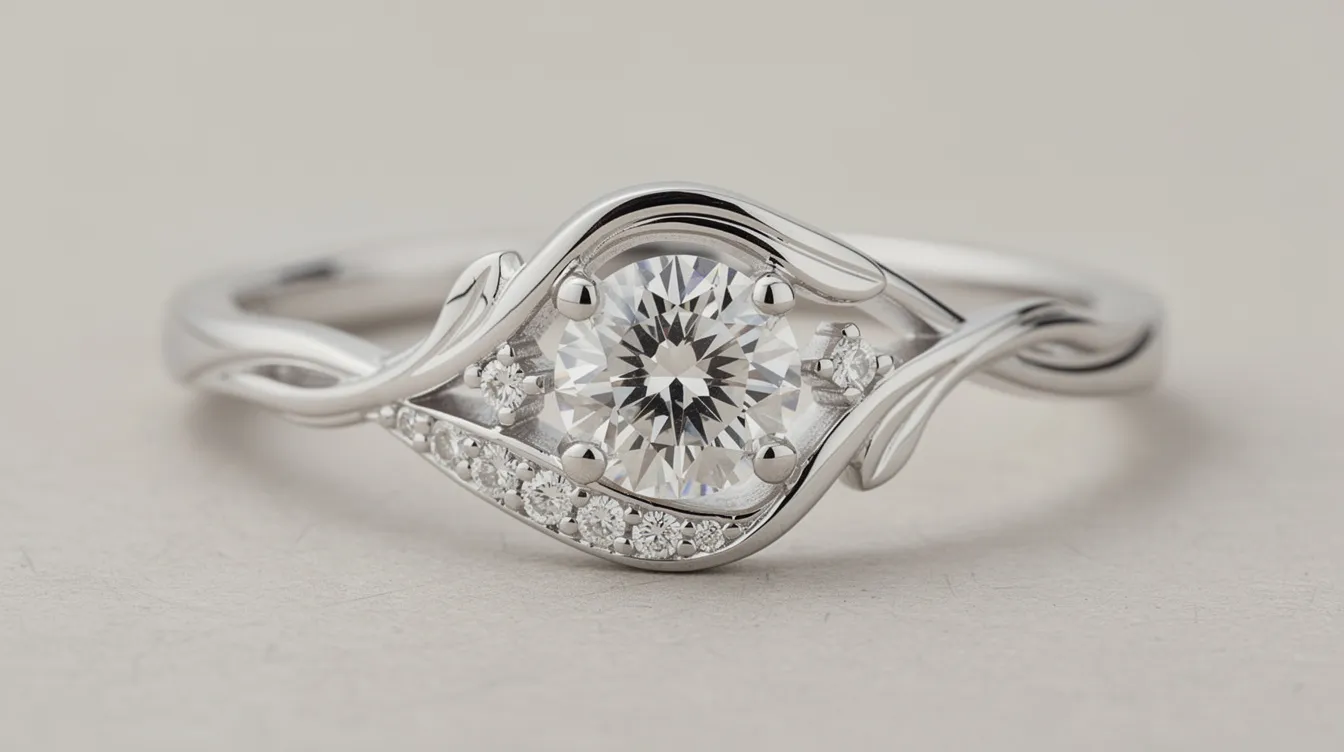
A custom engagement ring with an iris-inspired gallery surrounding an ethically sourced center diamond
-
A dragonfly pendant featuring lab-grown moonstone and modern plique-à-jour technique
-
A remodel transforming an inherited Victorian diamond into an art nouveau–style setting with flowing gold prongs and subtle botanical engraving
-
Men’s bands with engraved whiplash patterns and stylized ginkgo borders
These pieces prove that art nouveau aesthetics remain vital and adaptable—neither museum curiosities nor period costumes, but living design principles that continue to inspire meaningful jewelry.
Bringing Art Nouveau to Your Life
Whether you’re drawn to an original treasure from the c. 1890–1910 art nouveau era or a custom piece inspired by its flowing lines, the movement offers timeless possibilities for anyone who values artistry over mere display.
For collectors and enthusiasts in the San Francisco Bay Area and beyond, Trabert Goldsmiths offers multiple paths into art nouveau jewelry:
-
Curated vintage selection: Authenticated period pieces ready to wear or collect
-
Expert restoration: Bringing heirloom art nouveau pieces back to wearable condition
-
Custom design: New pieces inspired by period aesthetics, using lab-grown or ethically sourced stones
-
Consultation: Helping you understand and care for pieces you already own
We invite you to explore our vintage collection online or book a design appointment at our San Francisco showroom. The artistry of art nouveau awaits—whether in an original masterpiece or a new creation that carries the era’s spirit forward.
FAQ
How can I tell if a piece is truly from the Art Nouveau era and not just “in the style of”?
Authentic art nouveau pieces from c. 1890–1910 show specific period characteristics that distinguish them from later reproductions. Look for old-style clasps and fittings (modern safety catches are a red flag), period stone cuts like old European or rose cuts rather than modern brilliants, and wear patterns consistent with age—genuine patina develops differently than artificial aging.
Construction details matter enormously. Period hand-finishing leaves subtle tool marks and slight irregularities that machine production cannot replicate. Maker’s marks should be period-appropriate: Lalique, for instance, used specific signature styles that changed over time and can be authenticated against documented examples.
The most reliable approach combines self-education with professional evaluation. At Trabert Goldsmiths, we can examine suspected art nouveau pieces and provide authentication guidance, helping you understand what you have and what it’s worth. For significant purchases, we always recommend inspection by an experienced jeweler or appraiser who specializes in period jewelry.
Is Art Nouveau jewelry too delicate to wear every day?
Many original art nouveau pieces were designed for special occasions rather than daily wear, and their fragility reflects this original purpose. Plique-à-jour enamel is particularly vulnerable—the translucent enamel has no backing and can crack from impact or temperature shock. Carved horn pieces may warp or crack over time with exposure to heat and moisture.
However, sturdier pieces—solid gold rings, well-made pendants, and robust brooches—can tolerate more frequent wear with appropriate care. The key is understanding your specific piece’s vulnerabilities.
For everyday wear, we recommend:
-
Remove before any physical activity, housework, or bathing
-
Avoid extreme temperature changes
-
Store separately from other jewelry to prevent scratching
-
Schedule regular professional checkups to catch problems early
-
Consider having particularly fragile pieces professionally reinforced
If you love art nouveau aesthetics but need everyday durability, a custom new piece inspired by the era can be designed for modern lifestyle demands while honoring period design principles.
Can you adapt an heirloom diamond into an Art Nouveau–style setting?
Absolutely. Existing diamonds and gemstones can be beautifully reset into newly designed art nouveau–inspired mounts featuring flowing lines, floral galleries, and organic prongs that suggest natural forms rather than mechanical geometry.
This approach allows you to honor a sentimental stone—perhaps from a grandmother’s ring or an inherited pendant—while giving it fresh expression in a period-influenced, handcrafted setting. The result combines personal history with art nouveau’s artistic principles.
At Trabert Goldsmiths, we specialize in exactly this kind of heirloom reimagining. Our process begins with understanding both the physical characteristics of your stone and its emotional significance, then designing a new setting that serves both. We can incorporate specific art nouveau elements—iris-inspired galleries, whiplash curves in the band, subtle enamel accents—while ensuring the finished piece suits your lifestyle and aesthetic preferences.
Are there Art Nouveau designs that work well for men’s jewelry?
Period art nouveau men’s pieces included signet rings, stickpins, tie bars, cufflinks, and watch chains featuring subtle floral, animal, or Celtic-inspired curves. These pieces typically embraced art nouveau’s flowing lines while maintaining a more restrained aesthetic appropriate for men’s dress conventions of the era.
Modern interpretations for men might include:
-
Wedding bands with engraved whiplash patterns
-
Signet rings featuring stylized botanical motifs
-
Cufflinks with subtle enamel accents
-
Tie bars with sinuous, organic curves
These designs honor the art nouveau aesthetic without feeling ornate or overtly feminine. The key is selecting motifs and scales appropriate for men’s jewelry—ginkgo leaves, stylized waves, or Celtic-influenced curves work particularly well.
At Trabert Goldsmiths, we create men’s pieces that nod to art nouveau principles through line quality and natural inspiration rather than literal floral imagery, offering a sophisticated alternative to purely geometric contemporary designs.
Do you offer lab-grown diamonds or ethically sourced stones in Art Nouveau–inspired pieces?
Yes, art nouveau aesthetics can be paired perfectly with contemporary ethical choices. The original art nouveau jewelers valued artistic vision over material rarity—they happily used horn, glass, and semi-precious stones when these served their design goals better than diamonds. This philosophy aligns naturally with modern sustainability concerns.
We offer:
-
Lab-grown diamonds with identical optical and physical properties to mined stones
-
Traceable colored gemstones from responsible sources
-
Recycled precious metals
-
Ethically sourced moonstones, opals, and other period-appropriate gems
Combining art nouveau design principles with modern ethical sourcing creates jewelry that honors the movement’s artistic values while meeting contemporary standards. The result is pieces with authentic period spirit and clear conscience—exactly the kind of meaningful jewelry that matters most.